Policiacomunitaria

Rigorous political analysis for readers who want to understand the system, not just react to it.

Archives (page 7 of 12)

Project 2025 in Practice: A One-Year Audit of Executive Orders and Federal Restructuring Under the Second Trump Administration

The Scale of Change: When Executive Orders Become the Primary Tool of Governance

Let’s start with the numbers, because they matter when we’re talking about how government actually works. By January 2026, the Trump administration had issued over 140 executive orders in its first year. That’s not normal. To put it in perspective, you have to go back to Franklin Roosevelt during the Great Depression to find comparable first-year totals. The American Presidency Project executive order database tracks every one of these orders, and the velocity is what strikes observers across the political spectrum. When you can reshape federal policy through executive action at this pace, you’re operating in a different constitutional mode than most modern presidents.

Here’s what matters for you: executive orders are real. They move money. They redirect agencies. They affect benefits, hiring, regulations, and enforcement priorities. But they’re also temporary in a legal sense. Courts can strike them down. Future administrations can rescind them. They’re powerful but fragile, which is why understanding what’s happening in the federal courts right now is essential to understanding what actually sticks versus what becomes tomorrow’s political fight.

The Heritage Blueprint: When Think Tank Policy Meets Executive Action

The Heritage Foundation’s Project 2025 Mandate for Leadership document is a 900-page policy blueprint that reads like a contract for federal restructuring. What makes it worth paying attention to isn’t that think tanks write policy ideas. They always do. What matters is the documented connection: at least 60 specific policy actions have been directly cited as inspired by or based on this document, according to ProPublica’s federal policy change tracker. That’s not assumption or speculation. That’s documented traceability between a written policy proposal and actual federal action.

Why should you care about this level of detail? Because it tells you something important about how power is being exercised. This isn’t ad hoc decision-making. This is templated governance. The Heritage Foundation spent years organizing this blueprint. The administration has spent this year implementing it. Some of it might be good policy. Some of it might be misguided. But pretending it’s random or spontaneous misses what’s actually happening: a coordinated vision for federal power is being methodically installed.

The Reclassification Gambit: What Happened to Civil Service Protection

Now we get to the institutional part that should keep you awake at night, regardless of your politics. The Office of Personnel Management reported that approximately 24,000 federal employees were reclassified under Schedule F by mid-2025. That’s the new classification that strips civil service protections. Schedule F employees serve at will. They can be fired for political reasons. They can be replaced based on loyalty rather than competence. This is restructuring the federal workforce itself.

Here’s the honest tension: some argue this enables accountability and prevents bureaucratic obstruction. They say career employees sometimes resist legitimate policy changes. There’s a kernel of truth there. But here’s what worries experts across the ideological spectrum: civil service protections exist because we learned something in the 20th century. We learned that governments work better when you separate hiring and firing decisions from pure political patronage. We learned this through trial and error, often by living through corruption and instability firsthand. When you convert 24,000 positions from protected status to at-will employment, you’re not just shifting power. You’re removing institutional memory and replacing it with loyalty as the primary qualification. That’s a structural change that will outlast this administration regardless of which party wins next.

The Courts Strike Back: When the Judicial Branch Becomes the Brake

Federal district courts have issued over 90 nationwide injunctions against executive orders in the first 12 months of this administration. That’s the highest single-year count in modern judicial history, according to the Georgetown Law Center on Congressional Studies. Let that sink in. Ninety. Not all of these injunctions will survive appeal. Some are temporary. Some will be overturned. But the volume tells you something: the courts are treating this avalanche of orders as constitutionally suspect at a rate without modern precedent.

This is where things get genuinely complicated. Supporters of the administration argue the courts are being activist, blocking legitimate executive authority. Critics argue the administration is pushing beyond constitutional boundaries and the courts are doing their job. The evidence points to something messier than either side admits: the administration is testing the limits of executive power systematically, and the courts are pushing back on the most aggressive moves. Some of those moves will eventually be upheld. Some won’t. But this legal warfare isn’t background noise. It’s determining which policies actually stick and which get buried in litigation for years.

The Public Pulse: What Americans Actually Think About the Pace of Change

A January 2026 Gallup poll recorded presidential approval at 44%, with 61% of independents expressing concern about the pace of changes to federal institutions. That’s the group worth watching. Independents aren’t locked into partisan loyalty. They’re not automatically defending the administration or automatically opposing it. And six in ten of them are worried about how fast things are changing.

This matters because democracies need some baseline trust that institutions aren’t being dismantled overnight. You can disagree about policy. You can fight hard for your vision. But if the pace of institutional change outruns public consent, you’re building resentment that will explode in the next election cycle. This is true regardless of party. The urgency of change has to coexist with the legitimacy that comes from consent. Right now, that’s the real tension.

What Happens Next: The Research Assignment for Active Citizens

Here’s what I want you to do. Track one executive order from this administration. Pick one that affects something you care about. Follow it. See if it gets challenged in court. Check the arguments on both sides. Read what it actually does versus what the headlines say it does. That’s not partisan work. That’s what active citizenship looks like.

Then find out what your federal representatives’ actual positions are on Project 2025 and federal restructuring. Not their talking points. Their actual documented positions. Call their offices. Ask. Make them answer. That’s how democracy stays accountable. We’re living through a year that will reshape federal power for a generation. You don’t have to accept anyone’s conclusion about whether that’s good or bad. But you have to engage with the evidence yourself. The tools exist. They’re free. The question is whether you’ll use them.

NATO’s 2025 Hague Summit: When 3% Stops Being a Question and Becomes the New Reality

The Turning Point Nobody Expected to Reach So Fast

June 2025 is shaping up to be one of those moments in diplomatic history where everyone suddenly realizes the old playbook no longer applies. NATO’s gathering in The Hague isn’t just another summit on the calendar. It’s where a quiet revolution in European defense spending gets its formal stamp of approval. For decades, 2% of GDP was the magic number. Members pledged it. Some hit it. Many didn’t. The arguments happened predictably at every summit, usually with the United States on one side and everyone else negotiating for more time.

Now we’re talking about 3%. And here’s the thing that’s genuinely surprising: it’s actually happening. Not in some distant future scenario, but in real time, across multiple countries, driven by something no strategy paper predicted accurately: geography and fear.

The Math That Tells the Real Story

Start with the clearest data point. In 2014, when NATO formally adopted the 2% spending pledge at the Wales Summit, exactly three member states met that target. Three. Fast forward a decade and you’re looking at 23 of 32 members hitting or exceeding 2%. That’s not gradual change. That’s a complete reversal of the entire budget calculus across the alliance.

But the distribution tells you something even more important than the headline number. Poland is running at approximately 4% of GDP on defense. That’s not a token increase or political posturing. That’s a country that shares a border with an active conflict, where security spending has become a political consensus issue that transcends party lines. When your neighbor is fighting for survival, your budget priorities clarify fast.

Meanwhile, the United States continues to carry a disproportionate load. In 2024, American defense spending represented roughly 68% of total NATO expenditure despite the U.S. accounting for less than half the alliance’s combined GDP. That’s not new information, but it’s the statistic that keeps driving every serious conversation about burden-sharing. It’s also the number that shaped Trump administration arguments before 2025 and will likely continue framing these discussions going forward.

You can check the detailed breakdowns yourself. NATO Defense Expenditure Data and Reports publishes the annual figures with full transparency. The numbers are public. The implications are harder to ignore once you actually look at them.

Why European Voters Are Actually Supporting This

Here’s where the political picture gets interesting. Public opinion in Europe shifted dramatically, and the timing matters. A February 2025 Pew Research Center survey found that majorities across most NATO European member states now support increased defense spending. That’s a marked reversal from pre-2022 polling data, when skepticism about military expenditure ran much deeper.

What changed? Ukraine. An active, ongoing conflict on European soil that wasn’t theoretical anymore. Voters stopped treating defense budgets as abstract policy debates and started treating them as practical necessities. You see that shift in countries like Poland, sure, but also in Germany, where the political conversation around defense spending had been nearly frozen since the Cold War ended.

The Pew data matters because it suggests the 3% conversation isn’t going to collapse under public pressure the way previous spending increases sometimes did. When majorities of voters in your country think defense spending should go up, politicians have a much easier time voting for it. When that majority exists across most of NATO Europe simultaneously, you’re looking at structural change, not a temporary spike.

Pew Research Center NATO and European Security Surveys regularly update these trend lines. If you’re tracking public opinion movements, that’s the place to watch for actual data rather than commentary about what people supposedly think.

The Hague Summit as Formalization, Not Innovation

So what’s actually happening in June 2025? NATO leadership is taking a reality that’s already forming and codifying it. The 3% target isn’t being invented at the summit. It’s being acknowledged as the new floor because behavior is already moving that direction.

Think of it this way: when enough members are already spending at that level or moving toward it, and public opinion supports it, the formal adoption becomes almost ceremonial. But ceremony matters in international relations. Official commitments change how governments allocate budgets and how future leaders justify spending decisions. A formal 3% pledge gives countries political cover they might not otherwise have.

This matters differently for different members. For Poland and the Baltics, 3% is already happening. For Germany and France, it means a significant recalibration of post-Cold War assumptions. For smaller members, it might require difficult choices about other spending priorities. But the direction is set, because the external conditions that drove the change aren’t temporary.

What Comes After the Summit Adjourns

The real test isn’t in The Hague. It’s in the budget cycles that follow. It’s in whether the public opinion shift holds when citizens realize what 3% actually means for their tax bills, their healthcare spending, or their education budgets. It’s in whether countries that are struggling to hit 2% can actually make the jump to 3% without destabilizing their political systems.

The evidence suggests this is genuinely different from previous defense spending debates. The conditions that drove the change, geographic proximity to conflict, public support, broad alliance consensus, aren’t disappearing after the summit. But implementation at scale is always messier than commitments on paper.

Watch the budgets that get proposed in the months after The Hague. Watch which countries actually appropriate the funds. Track the political pushback when it arrives. Pay attention to whether the public opinion data continues tracking upward or starts sliding. This is democracy and international relations in action, and the outcome matters for how Europe approaches security for the next decade.

What’s your read on whether this shift will stick? Have you noticed this playing out in the news from your own country?

Trump’s 2025 Tariff Gamble: What the Reciprocal Order Actually Changes (And What It Doesn’t)

The April 2nd Shift: From Theory to Executive Action

On April 2, 2025, President Trump signed what he called a “Liberation Day” executive order that fundamentally reoriented how America thinks about tariffs. This wasn’t a tweak. This was a structural reset. The order imposed a baseline 10% tariff on virtually all imports, then layered on “reciprocal” rates designed to match what Trump administration officials claimed were unfair trade barriers maintained by other nations. China got hit hardest: a 34% additional tariff on top of existing duties that were already substantial.

Here’s what matters about this move from a systems perspective. For decades, American tariff policy operated within a post-World War II framework built on the idea that lower barriers benefit everyone over time. You heard the argument constantly: free trade raises living standards, encourages specialization, creates economic growth. The April order essentially said that framework has failed the American worker, and it’s time to weaponize tariffs as a negotiating tool and a protection mechanism simultaneously.

The specifics matter. A 10% baseline isn’t random. It’s high enough to be economically disruptive but potentially defensible as a negotiating floor. The reciprocal component is the real innovation here, though whether it’s strategic genius or economic theater depends on where you sit in the supply chain.

The Historical Echo: Smoot-Hawley and Modern Parallels

When the Peterson Institute for International Economics ran the numbers, they concluded the full tariff package represented the highest average U.S. tariff rate since the 1930s Smoot-Hawley era. That finding landed like a heavyweight punch in economics circles. Smoot-Hawley is basically the cautionary tale economists invoke when they want to show what happens when you let protectionism run unchecked.

But here’s where intellectual honesty matters. The comparison is instructive but imperfect. Smoot-Hawley was passed in the depths of Depression-era desperation with no reciprocal negotiating strategy. This 2025 order explicitly frames itself as a negotiating tool with a stated endgame: get other countries to lower their barriers, then reciprocate by lowering yours. That’s actually different from pure protectionism, at least in theory.

The question is whether the distinction holds up when you watch what actually happens next. Does the tariff pressure force real concessions? Or does it calcify into permanent barriers? That’s where the April order gets interesting and genuinely contested.

The Retaliation Cascade: What Happens When Everyone Plays Hardball

China responded in 72 hours with 34% counter-tariffs on American goods. The stock market reacted violently. The S&P 500 dropped roughly 10% over two trading sessions. That’s not a correction. That’s the market signaling genuine concern about trade war escalation.

The European Union did something it had never done before. They invoked a new Anti-Coercion Instrument that gave them authority to impose retaliatory measures on approximately 26 billion euros worth of U.S. exports. Think about what that signals. The EU didn’t just retaliate. They activated a new legal mechanism specifically designed for this kind of moment, which is institutional recognition that something structural has changed in global trade relationships.

Here’s where the honest assessment gets complicated. Those retaliations are economically harmful. They raise costs for American companies, reduce export markets, and create supply chain uncertainty. But they also demonstrate something important: the April order didn’t surprise people into submission. It triggered a symmetrical response. That matters because reciprocal tariff architecture only works if your trading partners believe the pain of escalation leads to negotiation, not a permanent economic cold war.

The 90-Day Pause and the Unresolved Beijing Question

The administration announced a temporary 90-day pause for most countries. That sounds like a cooling-off period, and in some ways it was. Most nations got breathing room to negotiate bilaterally. But China didn’t get that pause. China got tariffs, retaliation, and now, heading into early 2026, a situation where the Office of the United States Trade Representative is still reporting no comprehensive bilateral deal on the horizon.

This is the moment where you have to choose what story you’re telling about this order. If you believe the tariffs are leverage that forces better outcomes, then the unresolved Beijing situation is evidence the strategy needs more time or harder pressure. If you believe they’re counterproductive barriers that damage American consumers and businesses, then the persistence of high China tariffs is evidence the whole framework was misconceived.

Both positions are coherent. Both have evidence. An autoworker in Ohio might feel differently about these tariffs than a manufacturer importing components from Vietnam. A farmer selling soybeans globally experiences this policy differently than a steel producer facing Chinese competition. The April order didn’t create those conflicting interests. But it crystallized them.

What Happens Now: Systems, Consequences, and Your Civic Role

This is where my civics teacher energy kicks in, because this moment is actually about you and how you engage with complex policy questions. The tariff architecture doesn’t exist in the abstract. It affects employment decisions, price pressure at grocery stores, investment calculations, and international relationships. These are live questions being debated by people with real power.

Your job isn’t to accept the April order uncritically or reject it reflexively. Your job is to ask specific questions. Which American industries benefit? Which ones get squeezed? What’s the evidence that reciprocal tariffs actually produce better trade terms versus entrenching barriers? Are there alternatives that protect American workers without the retaliation risks? What happens if the China negotiations remain unresolved through 2026?

Those aren’t rhetorical questions. They’re research questions. You can actually investigate them by reading trade analyses, studying market responses, looking at specific sector impacts, and tracking USTR reporting on bilateral negotiations.

The April 2nd order redrew the trading system architecture. Whether that redraw helps or hurts American interests depends on execution, Chinese willingness to negotiate seriously, and whether the leverage actually converts into lasting agreements. We’re still watching that story unfold. What questions would help you understand it better? What specific impacts are you seeing in your own community?

Project 2025 in Practice: What Actually Happened When the Blueprint Met Reality

The Grand Vision Collides with Institutional Friction

When Donald Trump signed the executive order re-establishing Schedule F on his first day back in office, it felt like the opening bell for a sweeping reorganization of the federal workforce. The Heritage Foundation’s Project 2025 Mandate for Leadership, that massive 887-page document, had promised nothing less than a fundamental restructuring of how government works. But a blueprint and its implementation are two very different creatures, and anyone who’s watched how power actually operates knows that gap can be enormous.

Project 2025 in Practice: What Actually Happened When the Blueprint Met Reality

Let’s be honest about what happened. The Office of Personnel Management reported by mid-2025 that Schedule F reclassification had touched roughly 50,000 federal positions. That’s substantial. That’s real. But legal challenges from federal employee unions were actively working their way through multiple federal circuits. The story wasn’t over. It still isn’t. This is where institutional resistance shows up, not as a dramatic showdown but as grinding, bureaucratic persistence.

The Reality of Executive Action Versus the Hard Limits of Congressional Power

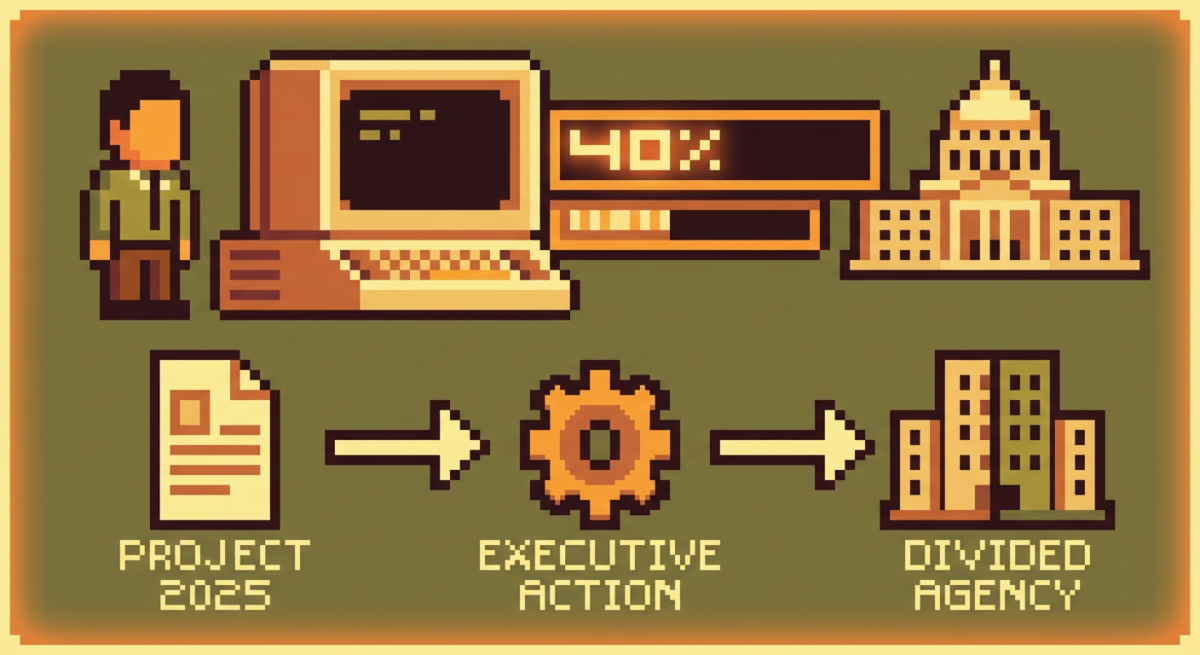
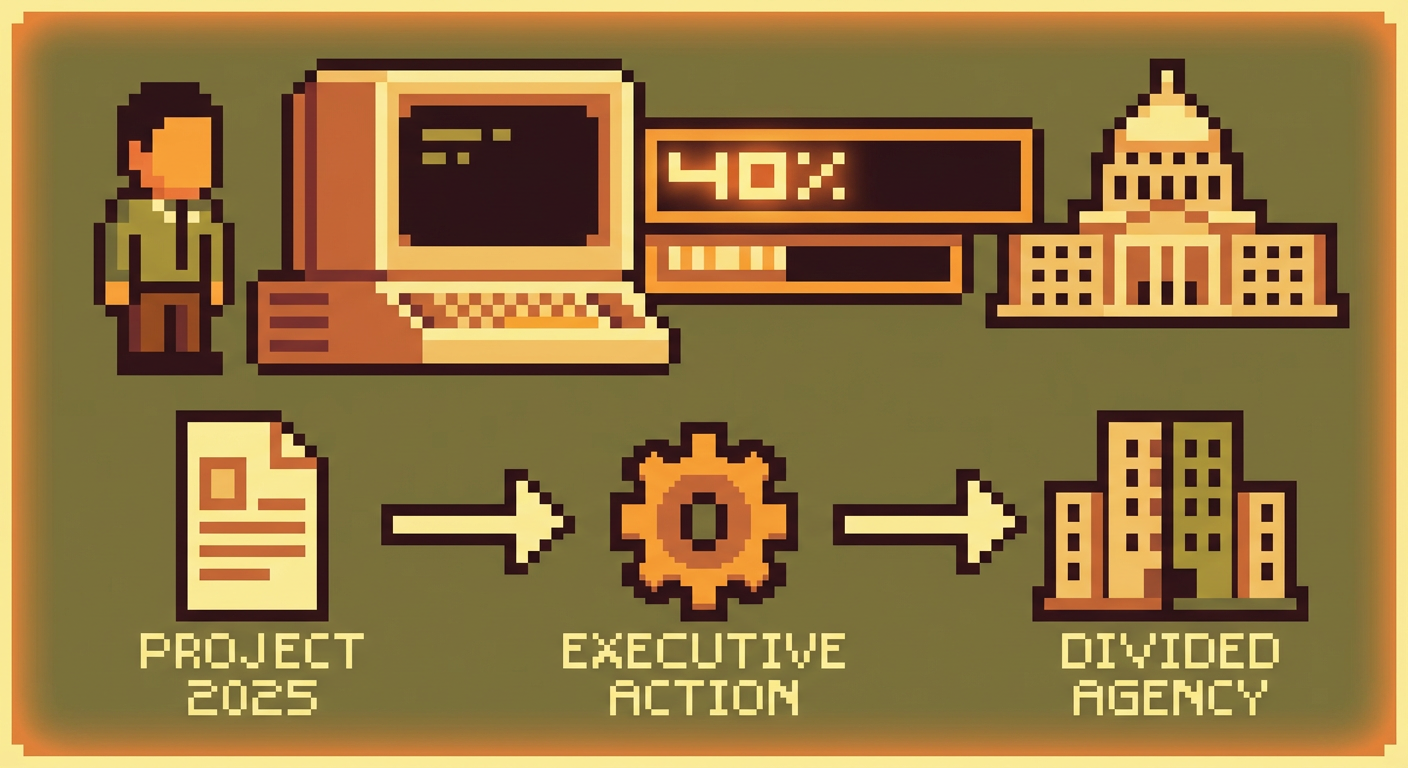
Project 2025’s architects had some clear wins on executive authority. According to a March 2025 analysis from the Brookings Institution Governance Studies Federal Workforce Analysis, roughly 40 percent of the project’s first-year federal agency restructuring recommendations were either partially or fully attempted through executive action. Forty percent. That’s not nothing. That’s demonstrable movement on the agenda.

But then came education policy. The Department of Education elimination was supposed to be a centerpiece. It’s in the document. It’s politically popular with a certain coalition. And it went nowhere, or more precisely, it went to Congress and hit a brick wall. Even with Republican control of the Senate, the math didn’t work. That 60-vote cloture threshold protecting the agency’s authorizing legislation meant you couldn’t just wave an executive pen and make a cabinet department disappear. You needed Democratic votes you weren’t going to get. The Senate filibuster, that old democratic anachronism, turned out to be very much real.

This distinction matters. Executive action could shuffle tens of thousands of civil servants into new classifications. It could reorganize agency priorities and reassign reporting lines. But it couldn’t eliminate a department or rewrite the laws that created one. The Constitution has opinions about this stuff.

The Hidden Cost: What Attrition Actually Reveals

Here’s what keeps me thinking about all this. Federal employee attrition at agencies targeted by efficiency reviews ran at nearly triple the historical baseline rate in the first half of 2025. That data comes from the Partnership for Public Service Federal Workforce Data, and it tells a story that goes beyond the headline numbers.

When you’re trying to reshape government institutions, you’re not just moving boxes on an org chart. You’re creating conditions that affect real people’s lives and, consequently, their decisions about where to work. Experienced civil servants started leaving. Some left out of principle. Some left because the job became untenable. Some left because they saw the writing on the wall and decided to land somewhere else first. The question becomes: what institutional knowledge walks out the door with them? What relationships built over decades get severed? What gets lost that you can’t rebuild by hiring new people, no matter how dedicated they are?

This is where implementation gets messy in ways that policy papers never anticipate. You can technically accomplish a restructuring, reclassify workers, tighten oversight, reorganize chains of command. But if the people who actually know how things work are heading for the exits, you’re left with capability problems that look like success on the org chart but feel different on the ground.

Which Blueprints Actually Survived Contact with Reality

So what actually worked? Schedule F happened. Not completely, not unopposed, but it happened in a substantial way. The reclassification of 50,000 positions is real institutional change, lawsuit or no lawsuit. That counts as implementation.

The executive action restructurings? Most of those advanced, at least partially. If you’re tracking which policy blueprints became reality, executive-action-dependent ones generally did, because the president gets to try things unilaterally and see if courts stop him. That’s how executive power works in practice.

The legislative ones? Those mostly stalled. Education Department elimination, various statutory changes, the things that required Congress to affirmatively do something, all hit the procedural barriers that reliably stop these initiatives. The Senate filibuster, the need for Democratic votes, the complexity of unwinding statutory authorities. These aren’t bugs in the system. They’re features, and they’re how institutional resistance manifests in a separated-powers system.

The Larger Pattern: Implementation Reveals What Was Always True About Power

Here’s what I find genuinely educational about all this, and I mean that word seriously. Implementation of Project 2025 revealed something we ought to have already known but somehow keep forgetting: executive power is real and substantial, but it has a ceiling. That ceiling isn’t rhetorical or theoretical. It’s institutional. It shows up in court and in Congress and in the everyday decisions of 50,000 federal employees trying to figure out what their jobs mean now.

The blueprint was ambitious. Some of it became reality. Some of it didn’t. Most of what became reality involved executive authority. Most of what stalled involved Congress. That’s not unique to this administration. That’s the architecture of how American government actually works, and it works that way by design.

If you’re trying to understand what happens when grand visions meet institutional reality, Project 2025’s implementation record is a useful case study. Not a narrative of complete triumph or complete failure, but an illustration of how power gets distributed, how resistance operates, and where the real limits actually lie. What questions do you have about how these dynamics played out in your own sphere of influence?

The Firewall Breaks: What Germany’s February 2025 Election Means for Democracy After Merz’s Gamble

When the Numbers Shifted

Let’s start with what the ballot box actually told us. On February 23, 2025, German voters delivered their verdict, and the results were sharp enough to reshape the entire political landscape. The CDU/CSU, led by Friedrich Merz, captured approximately 28.5% of the vote—their strongest showing since 2017, a solid mandate from the electorate. But here’s where the story gets complicated: the second-place finisher was the Alternative for Germany (AfD) with roughly 20.8%. That’s not a minor far-right presence anymore. That’s a structural fact about German politics that every coalition builder has to navigate.

Meanwhile, the Social Democrats under Olaf Scholz hit rock bottom. Around 16.4%, the worst federal result for the SPD in the entire postwar period. Think about that for a second. West Germany’s founding party, the center-left anchor of democratic reconstruction after 1945, finished third and effectively ended the Scholz chancellorship in one election night. The Greens held steady in the mid-teens, and the Left and FDP fought for scraps. You can read the official tabulation yourself at the Bundestagswahl 2025 Official Results — Federal Returning Officer.

The Firewall That Wasn’t

Here’s the thing about political rules: they’re only rules until someone breaks them. In early February 2025, Friedrich Merz did exactly that. He accepted AfD votes to pass a migration motion through the Bundestag. Not as part of a formal coalition. Not through some complicated backroom deal. He simply let the math work where far-right votes counted toward his majority. In parliamentary democracies, that’s like watching someone casually ignore a “do not cross” sign that’s been in place for decades.

The reaction was immediate and massive. Over 100,000 people flooded German streets in protest within days. Berlin, Munich, Hamburg, Cologne, city after city saw demonstrations against what critics called the normalization of the far-right. Teachers wore pins. University professors published open letters. Local politicians scrambled to distance themselves. You could feel the shock in the political system itself. Merz had crossed what Germans call the “firewall,” the unwritten agreement across all mainstream parties that the AfD would be isolated, never collaborated with, excluded from parliamentary arithmetic.

Was it tactical? Strategic? A miscalculation? Merz later insisted the vote was about policy substance, not coalition-building. But the damage to Germany’s postwar consensus was already done. You can’t uncross certain lines in democratic politics.

The Consensus Fractures

For eight decades, there was something called the postwar consensus. It meant that despite real disagreements, German political elites agreed on certain fundamentals: the EU was good. NATO membership was settled. Democracy itself was non-negotiable. The AfD challenged that consensus starting in 2015. By 2025, something had shifted in how mainstream parties engaged with that challenge.

When Merz’s CDU/CSU formed its new coalition in spring 2025, it didn’t include the AfD formally, but the psychological barrier had eroded. Other mainstream parties watched what happened and drew their own conclusions about their leverage. The Greens and SPD had less of it. The FDP was out of the picture entirely. For Politico Europe: Germany’s Coalition Negotiations Tracker, this was the big story, not just who governed, but how the rules of governing had changed.

Some analysts called it pragmatism. Others called it capitulation to populism. Honestly, the evidence suggests it was both: pragmatic because Merz faced real constraints, but capitulation because he chose to break the firewall rather than accept the arithmetic he’d been dealt. In politics, those choices have echoes.

Economics and Institutional Trust

Coalition governments need more than votes to function. They need room to maneuver. The Merz government got neither. The Bundesbank was already projecting a 0.2% GDP contraction for 2025 when the new cabinet took office. The constitutional debt brake, Germany’s famous fiscal rule, suddenly became a constraint rather than a principle. How do you stimulate an economy when your legal framework forbids deficit spending? That tension defined every budget negotiation.

But the economic pressure wasn’t what damaged German institutions most. Trust did. According to Politico’s Europe Confidence Tracker from late 2025, institutional trust among voters under 35 collapsed by 11 points compared to just two years earlier. Young Germans were losing faith in their federal government faster than any other demographic. Why? Because they watched their leaders break a fundamental rule and concluded that rules were malleable. If the mainstream could collaborate with the far-right when convenient, what exactly was the system protecting?

What You Should Know Going Forward

Democracies don’t fail in one dramatic moment. They fail through a thousand small decisions where norms get bent and people stop believing the rules apply equally. What happened in Germany between February and spring 2025 was exactly that kind of moment. Merz didn’t destroy German democracy. He just proved that its guardrails were maintained by habit, not by law.

The real work happens now, not in parliament, but in every city council meeting, every community organization, every conversation where people decide whether these norms matter. Because here’s what decades of studying local politics teaches you: institutions are only as strong as the people who defend them. The numbers from February are real. The protests were real. The fracture in the postwar consensus is real. What happens next depends on what ordinary Germans decide to do about it.

What’s your read on this? Have you seen similar institutional shifts in your own country’s politics? I’d genuinely like to hear what you’re seeing on the ground.

The EU AI Act’s 2025 Deadline Just Changed the Game for Tech Companies Everywhere

Why This Moment Matters More Than You Think

Here’s something that happened quietly in August 2025 that should make you sit up and pay attention. The European Union’s AI Act stopped being theoretical and became real. The provisions governing high-risk AI systems formally kicked in. That means companies using AI for things like hiring decisions, loan approvals, and criminal justice recommendations suddenly had to prove they were doing it responsibly. They needed conformity assessments. They needed to show their work. They needed human beings actually paying attention to what their algorithms were doing.

This wasn’t a suggestion. This was law. And it matters because Europe just showed the world that governments can actually regulate artificial intelligence before the technology gets completely out of hand. That’s the kind of move that reshapes entire industries.

How the EU Actually Did This

Let’s break down what happened. The EU didn’t ban AI. They didn’t panic and freeze everything. Instead, they built a risk-based classification system. Think of it like how we regulate medications. We don’t ban all drugs, but we require different levels of testing and oversight depending on how serious the health risks are.

High-risk AI systems now face real requirements. Companies have to run conformity assessments. They have to provide transparency disclosures so people know when they’re interacting with AI. They have to actually build in human oversight mechanisms so that an algorithm isn’t the final decision-maker on something that affects someone’s life. If you want the specifics, you can find them at the EU AI Act Official Text and Timeline, but the core principle is simple: if AI can seriously harm someone, a human needs to understand and validate what the AI is doing.

And here’s where it gets uncomfortable for tech companies. The penalties aren’t theoretical either. Violations of the most serious provisions can cost you up to 35 million euros or 7 percent of your global annual turnover, whichever number is bigger. For some companies, that’s a devastating amount of money. That kind of financial muscle behind a regulation changes behavior overnight.

The Three-Way Split That’s Actually Reshaping Global Tech

Here’s where this gets really interesting from a governance perspective. We’re not watching one country figure out AI regulation. We’re watching three completely different visions of AI governance set themselves up as global templates.

The EU just built a rights-based, transparency-focused system. Meanwhile, the United States is still stuck in neutral. There’s no comprehensive federal AI governance law as of early 2026. Instead, you’ve got a patchwork of state-level legislation, and the whole conversation is still reverberating from California’s veto of AB 1047 back in 2024. Different states are trying different approaches, which creates a messy situation for companies navigating fifty different rule books.

Then there’s China. Their Generative AI Regulations have been in force since 2023, and they’re explicit about what matters: AI-generated content has to align with core socialist values. That’s a fundamentally different approach than either the EU or the fractured US system. Less about transparency and individual rights, more about state values and control.

Think about what this means. A company building an AI system now has to ask itself which version of AI governance it’s actually building for. The EU version demands transparency and human oversight. The US version is still figuring it out. The Chinese version demands alignment with state values. You can’t build one AI system that equally satisfies all three. You have to make choices.

The Governance Scramble Is Real and Accelerating

What’s almost as striking as the EU’s actual regulation is how many other countries are suddenly paying attention. The OECD reported that 69 countries had adopted or were developing national AI strategies as of 2025. That’s a massive jump from just 17 countries in 2017. That’s not a gradual trend. That’s a scramble. Countries watched the EU move and started asking themselves whether they want to be left behind in this conversation.

You can see the full picture at the OECD AI Policy Observatory, and if you spend time looking at what different countries are doing, you get this messy, complicated picture of the world trying to govern something incredibly powerful that most governments don’t fully understand yet.

What This Means for People Who Care About How Power Actually Works

Here’s why I think you should care about this. This is democracy in action, but not the voting kind. It’s a much quieter thing. Governments looking at a technology that could reshape society and deciding whether they’re going to let companies regulate themselves or actually step in and set boundaries.

The EU looked at AI and said, “We’re going to take this seriously and build rules before there’s a crisis.” That’s the kind of decision that either works really well or creates all kinds of problems. It might slow innovation. It might protect people from algorithmic discrimination. Probably it does some of both. But the point is they chose to govern it rather than hope for the best.

That choice is rippling globally. Countries are watching. Companies are scrambling. The tech industry is learning that regulation isn’t theoretical anymore. And if you care about how technology shapes society, or how power gets distributed, or how we manage new capabilities democratically, this is the moment to pay attention. The rules are still being written. The precedents are still being set. Nothing here is predetermined.

Want to dig deeper into how your country or state is approaching AI governance? Look it up. Check the OECD AI Policy Observatory. Read what your local tech companies are doing. Follow the regulations your government is proposing. These are the decisions that will shape what AI actually becomes in your life. Unlike a lot of policy stuff that feels distant and abstract, this one is moving fast enough that paying attention right now means you can actually understand it before the major pieces are set.

Germany’s February 2025 Election: Why Friedrich Merz’s Narrow Victory Matters for All of Europe

When Slim Majorities Reshape Continents

Let me walk you through something that happened on February 23, 2025, that deserves more attention than it got in most news cycles. Germany held a federal election. Sounds straightforward. But the arithmetic that followed, and the coalition that emerged from it, tells us something crucial about the state of European democracy and stability right now. Friedrich Merz and the CDU/CSU won roughly 28.5 percent of the vote. That’s their best showing since 2017. It sounds solid. It isn’t.

Germany's February 2025 Election: Why Friedrich Merz's Narrow Victory Matters for All of Europe
Germany’s February 2025 Election: Why Friedrich Merz’s Narrow Victory Matters for All of Europe

Here’s where it gets interesting for anyone paying attention to how democracies actually function. A 28.5 percent plurality in Germany doesn’t automatically translate to power. The Bundestag has 630 seats, which means you need 316 to form a government. The CDU/CSU’s coalition math was tight. Uncomfortable. By April, Merz had secured the chancellorship leading a grand coalition with the SPD. Their combined vote share gave them a working majority. But “working” is the operative word here.

To understand why this matters beyond Berlin, you need to understand what a slim majority actually costs a government. Every legislative priority becomes a negotiation. Your coalition partners have leverage. And leverage, in a fractious moment for Europe, is worth examining closely.

The Historical Pattern: Grand Coalitions as a Sign of Fragmentation

Let’s put this in perspective. This is Germany’s third grand coalition (GroKo) since 2005. Three times in two decades, the two largest centrist parties had to climb into bed together because no other arithmetic worked. Think about what that signals. The political center isn’t holding its ground anymore.

Historically, grand coalitions aren’t a sign of political health. They’re a symptom. Weimar Germany saw them repeatedly in the late 1920s, each one more unstable than the last. Post-war German democrats learned this lesson. They designed their system to avoid exactly this scenario. And yet here we are.

The difference between 1920s Weimar and 2025 Berlin is profound, and that matters. Modern Germany has institutional guardrails. But the pattern is worth noting: when your two biggest moderate parties have to govern together, it usually means the extremes are growing and the political space between them is shrinking.

The Numbers That Should Concern You: The AfD’s Historic Performance

The real story of February 2025 isn’t what the CDU/CSU won. It’s what the AfD achieved. The right-wing Alternative for Germany pulled in roughly 20.8 percent of the vote. Their best-ever federal result. They’re now the second-largest party in the Bundestag. Let that sink in for a moment.

The SPD, meanwhile, collapsed to around 16.4 percent. Chancellor Scholz’s party suffered its worst federal election result since the end of World War II. When your governing coalition partner is losing that badly and your opposition is surging, your coalition becomes more fragile, not less.

This is where historical analogies get tricky, and I want to be careful here. We’re not in a Weimar scenario. German institutions are stronger. The economy is more robust. The rule of law functions. But the trajectory—mainstream parties shrinking, extremes expanding—that’s a pattern historians recognize. And it should prompt serious thinking about what happens when Merz’s slim majority faces its first real test.

The Deficit Crisis: Where Coalition Cracks Will Show

Here’s the practical challenge that will define whether this coalition holds. Germany faces a structural deficit exceeding 100 billion euros. That’s not a rounding error. That’s a policy crisis waiting for a decision. And the decision is going to hurt.

The centerpiece of this debate is the Schuldenbremse, Germany’s constitutional debt brake. It’s been the fiscal backbone of German politics for over a decade. Reforming it means amending the constitution, which requires a supermajority. In theory, the CDU/CSU and SPD have those numbers. In practice, constitutional reform requires consensus that goes beyond arithmetic.

Coalition partners disagree on whether to reform the debt brake or cut spending to meet it. The SPD will push for flexibility. The CDU/CSU traditionally favors stringency. With such a narrow majority, both sides have leverage to demand concessions. Merz will have to choose between appeasing his coalition partner and disappointing the fiscal hawks in his own party. That’s the kind of choice that tests coalitions. It’s the kind of choice that, under pressure, can break them.

European Stability and the Cost of Weak Governments

Why should you care about German coalition math if you don’t live in Germany? Because Europe’s stability depends on Germany having a functioning, reasonably coherent government. Germany is the continent’s largest economy. It’s the engine of EU policymaking. When Germany has a weak government, Europe feels it.

A government with a slim majority operates differently than one with a comfortable buffer. It’s more reactive. Less able to take strategic risks. More vulnerable to external shocks. If you’re thinking about Ukraine policy, industrial competitiveness, climate regulation, or any of the major questions facing Europe, German government stability matters.

Merz comes to office with genuine experience and a track record as a serious operator. That’s not nothing. But he’s leading a coalition where both parties have reasons to be cautious. The CDU/CSU wants to prove fiscal discipline. The SPD wants to prove it can deliver for workers facing cost-of-living pressure. These aren’t irreconcilable goals, but they’re not automatically aligned either.

Looking at the Federal Returning Officer official 2025 Bundestag results and checking the Bundestag official website on the 21st German Parliament, you can trace exactly how narrow the coalition’s margins are. That’s not just German politics. That’s European politics.

What This Means for Democracy in Practice

Here’s what I find genuinely interesting about this moment, and why I keep coming back to it. Merz’s slim majority is a test of democratic governance under pressure. Can a centrist coalition hold together when facing fiscal crisis, institutional challenges, and rising extremism on both flanks? We’re watching that experiment in real time.

The answer matters beyond Germany. It tells us something about whether modern liberal democracies can manage difficult problems with narrow majorities. Can they compromise? Can they lead decisively without overwhelming consensus? Can they stay coherent when it would be easier to fracture?

These aren’t abstract questions. They’re the practical machinery of how democracies survive moments of stress. Merz and his coalition have narrow margins. History suggests that tests them. We’ll see how they respond when the real pressure comes. If you’re interested in how democracies actually function—not in theory, but in the grinding work of coalition management and legislative compromise—Germany over the next several years is exactly where to look. What questions are you thinking about regarding this election and its implications for European politics?

Germany’s February 2025 Election: Why This Matters Beyond Europe’s Borders

The Results That Surprised Almost Nobody (And Everyone)

On February 23, 2025, Germans voted. The Christian Democrats under Friedrich Merz won with roughly 28.6% of the vote, securing the chancellor’s seat. This wasn’t a shock. But here’s what should grab your attention: the runner-up came in at about 20.8% of the vote. That runner-up was the AfD, Germany’s far-right party, posting its strongest federal performance ever. This combination tells you something crucial about the state of European democracy right now.

Germany's February 2025 Election: Why This Matters Beyond Europe's Borders
Germany’s February 2025 Election: Why This Matters Beyond Europe’s Borders

The Socialist Democrats cratered. The SPD pulled in around 16.4%, marking their worst federal result since World War II. That’s not exaggeration. That’s historical. If you want to understand what’s happening in Europe’s largest economy, start there. The traditional center-left party that shaped postwar German politics just lost more than half its support compared to the previous election.

For verified details on the exact vote totals and seat distributions, Official German Federal Returning Officer Results provides the official data. It’s the kind of primary source that cuts through commentary and lets you see the numbers themselves.

The Structural Constraints That Actually Run the Show

Here’s where American readers need to pay attention. Germany’s new government doesn’t get to just spend its way out of problems like some democratic systems can. There’s a constitutional debt brake that limits new borrowing to 0.35% of GDP. That’s not a policy preference. That’s a constitutional requirement. Now imagine you won an election and immediately discovered you’re bound by rules that severely limit your fiscal flexibility. That’s Merz’s reality.

This creates real tensions fast. Europe faces genuine challenges: military spending needs are rising because of the security situation in Ukraine. Infrastructure requires investment. Social programs have constituencies. But the money available is constrained by constitutional law. This isn’t a temporary budget issue. It’s structural gridlock baked into the system itself. When voters choose a new government expecting change, and that government discovers it has limited tools to deliver, frustration doesn’t take long to build.

Meanwhile, the Bundestag itself got smaller. After electoral reforms, the parliament now has 630 seats instead of the 736 it had before. That’s the smallest parliament in decades. Fewer seats means less legislative flexibility, more consolidated power, and potentially less representation of diverse viewpoints.

Why the AfD’s Second-Place Finish Is the Real Story

Don’t get distracted by Merz winning. The actual story is that a party most mainstream German political leaders won’t work with just secured 20.8% of the vote. The AfD remains toxic for coalition purposes. No major party will partner with them. But they’re too big to ignore, and their voters clearly feel something that existing parties aren’t addressing. That’s the pattern across Europe and increasingly in the United States too: voters choosing outsider parties not because those parties are competent, but because voters feel abandoned by established alternatives.

This creates a specific problem. You have growing electoral strength for a party that’s systematically excluded from power. That’s politically volatile. People don’t stay patient when they vote for someone and that someone gets locked out of decision-making. They either disengage or push harder. Neither outcome strengthens democratic institutions.

What This Means for American Politics

You might be wondering why German election results matter if you’re focused on American politics. Here’s the practical answer. Germany is the economic engine of Europe. It’s NATO’s largest European member. It’s a critical partner on everything from trade to security. When Germany’s political center destabilizes, ripples move outward fast. But beyond international relations, there’s a lesson about how established parties lose ground.

The SPD’s collapse happened in a country with proportional representation, strong unions, generous social programs, and a political culture that prizes consensus. They had structural advantages. Yet they still lost half their support in one election cycle. That happened because voters concluded the party wasn’t delivering on its core promises. Economic stagnation, immigration tensions, and a sense that traditional parties weren’t taking voter concerns seriously did the work. These are dynamics that operate across different political systems.

For detailed coverage tracking how these dynamics played out, DW News German Election Coverage Hub provides context and analysis from a source embedded in German political culture.

The Question Forward

What happens when a government takes office constrained by debt brakes, facing voter frustration that fueled extreme party growth, with a smaller parliament? We’re about to find out. Merz will form a government. He’ll run into fiscal limits quickly. The AfD will sit in opposition growing its organizational capacity and media presence. Germany’s political equilibrium just shifted in ways that won’t resolve in a single election cycle.

This is the moment where democratic systems either demonstrate resilience or reveal fragility. How Merz’s coalition handles fiscal constraints while managing legitimate voter dissatisfaction will shape European politics for years. And how those dynamics play out will tell us something about whether established democratic parties across the world can actually reform and rebuild trust, or whether we’re watching a realignment that goes deeper.

The data is public. The trajectory is visible. What we do with that information, how we understand it, and what we learn about maintaining democratic institutions when they’re under stress, that’s on us. What’s your read on where this goes?

The Gaza Ceasefire Collapse and What the UN Security Council Vote Actually Reveals About Great Power Competition in 2026

When a Deal Isn’t Really a Deal

Let’s start with what actually happened, because the headlines got this partly wrong. In January 2025, there was a ceasefire agreement. Phase One lasted 42 days. During those six weeks, 33 Israeli hostages came home, Palestinian prisoners were released, and the guns quieted. It sounds straightforward when you read it that way. But here’s what matters: everyone knew Phase Two was the real negotiation. Phase One was the trust-building exercise. And by March 2025, Phase Two talks had stalled completely.

The Gaza Ceasefire Collapse and What the UN Security Council Vote Actually Reveals About Great Power Competition in 2026

This matters because it tells you something about how international diplomacy actually works versus how we often discuss it in the abstract. When mediators like Qatar, Egypt, and the United States broker these agreements, they’re not solving the underlying conflict. They’re creating temporary breathing room while they try to figure out if the parties can move toward something more permanent. The collapse of Phase Two means that breathing room didn’t lead anywhere. The fundamental disagreements that existed in January still existed in March, and they still exist now.

The Security Council Theater and American Veto Power

Here’s where things get geopolitically interesting. Throughout 2025, the UN Security Council held nine emergency sessions on Gaza. Nine times the permanent members sat down to formally address this crisis. And here’s the number that should catch your attention: the United States vetoed three separate resolutions related to a permanent ceasefire.

I want to be fair here, because this is where analysis gets easy to oversimplify. The US vetoes weren’t reflexive defenses of Israel without content. Each veto involved different proposed measures, different language, different stakeholders arguing for and against. But the pattern itself tells you something important about American strategic positioning heading into 2026. The US chose to block permanent ceasefire language while simultaneously serving as a primary mediator. That’s not a contradiction exactly, but it’s a real tension. It signals that American diplomatic strategy prioritizes something other than a locked-in permanent settlement right now.

Compare this to how other permanent members behaved. Compare it to the shifting patterns you’ll see in 2026 as countries recalibrate their Middle East strategies ahead of the next election cycle. That’s what matters about the Security Council breakdown. It’s not a failure of diplomacy. It’s diplomacy working exactly as designed for states pursuing strategic interests.

The Humanitarian Reality Behind the Diplomatic Stalemate

While negotiators were working through language about permanent ceasefires and security arrangements, something else was happening on the ground. The UN Office for the Coordination of Humanitarian Affairs reported in late 2025 that over 2.1 million Palestinians in Gaza remained dependent on international humanitarian assistance for food security. More than 2 million people. Not facing potential food insecurity. Dependent on humanitarian assistance. Right now. Today.

I mention this not to make an emotional argument, though the human reality is obviously significant. I mention it because it’s the constraint that actually shapes 2026 geopolitics in ways the Security Council votes don’t directly capture. UN OCHA Gaza Humanitarian Situation Reports have become the baseline data that international mediators work from. When Qatari foreign minister Mohammed Al-Khatija conducted over 40 documented shuttle diplomacy trips throughout 2025, he was operating in a space where the humanitarian situation is a fixed reality, not a variable that can be negotiated away.

This creates pressure on all the mediating parties, a kind of urgency that doesn’t show up in the official statements. Egypt and Qatar can’t simply maintain the status quo indefinitely because the humanitarian cost has political consequences in their own countries and throughout the region. That’s actually why the mediation continued even as formal negotiations stalled. The humanitarian reality keeps forcing actors back to the table.

The International Court and the Longer Shadow

Now let’s talk about something that gets less attention than the Security Council drama but might matter more for 2026. The International Court of Justice issued two additional provisional measures orders in 2025 related to the Gaza conflict. In its March ruling, the court specifically cited obligations under the Genocide Convention. International Court of Justice: Gaza-Related Proceedings are ongoing, and these provisional measures orders aren’t advisory suggestions. They’re binding legal obligations on states.

This creates a different kind of pressure than the Security Council generates. Permanent members can veto resolutions. They can’t veto ICJ orders without walking away from the international legal framework itself, which is a much bigger cost than blocking one resolution. So what you’ll see in 2026 is the International Court functioning as a backstop that constrains what major powers can actually do, even when their immediate interests might suggest different actions.

The relationship between Security Council dynamics and ICJ constraints is genuinely new territory here. It’s not that courts have never bumped up against big power politics. It’s that this specific configuration of legal obligations and geopolitical interests is forcing a different kind of negotiation. The US can veto a Security Council resolution. But if the ICJ says states have obligations under the Genocide Convention, that’s a different legal and political reality altogether. This tension is going to shape how mediators approach 2026 talks.

What This Actually Tells You About the Year Ahead

Let me be direct about the conclusion I draw from all this. The collapse of Phase Two wasn’t a failure of mediation. It was evidence that mediation has limits when the underlying parties haven’t shifted their bottom lines. The Security Council votes weren’t an obstacle to peace. They were expressions of how major powers are actually thinking about their strategic interests. The humanitarian situation isn’t separate from the diplomacy. It’s the constraint that keeps diplomacy happening even when formal negotiations have stalled.

So what does 2026 look like? My honest read: continued mediation without breakthrough, continued humanitarian crisis, and continued legal pressure from the International Court. More Security Council sessions. The pattern of US vetoes will either hold or shift depending on how American strategy evolves. What we probably won’t see is another attempt at a phased ceasefire like the January 2025 deal unless something fundamental changes about what the negotiating parties are actually willing to accept.

That doesn’t mean progress is impossible. It means real progress requires something different than what was tried in 2025. The next mediator who tries to broker a deal has to work within the legal constraints the ICJ has established and account for what the Security Council votes actually revealed about strategic interests. That’s valuable information, even if it’s not the news anyone wanted to hear.

What’s your reading of how this shapes up going forward? Have you been following the mediation efforts, or are there specific aspects of the Security Council dynamics or the humanitarian situation you want to dig into more? The research is there if you want to go deeper into any of these pieces.

When International Law Meets Reality: The ICJ Gaza Opinion and Why Institutions Matter More Than You Think

The Advisory Opinion That Changed Everything (And Maybe Nothing)

In July 2024, the International Court of Justice issued something rare: a direct, unambiguous ruling on the legal status of occupation itself. After decades of carefully worded opinions, the court declared Israel’s occupation of Palestinian territories unlawful under international law. This was historic. This was also, in many ways, the beginning of a much more interesting story about how institutions actually work when they collide with geopolitical reality.

When International Law Meets Reality: The ICJ Gaza Opinion and Why Institutions Matter More Than You Think

Here’s what matters: this wasn’t a binding decision like you’d get in a typical court case. It was an advisory opinion, the court’s professional judgment on a legal question. The UN General Assembly asked the question, and the court answered. That sounds less powerful than it is. Advisory opinions shape international norms. Governments and human rights organizations cite them. They create a formal, documented record that becomes part of international law’s fabric.

What happened next is where this gets genuinely instructive about how global governance functions. The opinion didn’t end the occupation. But it did something almost as important: it shifted what countries could say in polite company.

Illustration for When International Law Meets Reality: The ICJ Gaza Opinion and Why Institutions Matter More Than You Think

The UN Resolution and the Twelve-Month Test That Failed

By September 2024, the UN General Assembly passed UN General Assembly Resolution ES-10/24 with 124 countries voting in favor. The resolution demanded compliance with the ICJ opinion. It called for an end to the occupation within twelve months. It was specific. It was ambitious. It was also, crucially, completely unenforceable.

That twelve-month deadline came and went without consequences. This frustrates people. It should frustrate people. But it also teaches us something about how international institutions actually function. They don’t have armies. They can’t arrest leaders or seize assets the way a national government does. What they have is legitimacy, documentation, and the ability to build pressure over time.

This is where I want you to think like a civic organizer instead of someone waiting for a savior institution to fix things. When 124 countries vote the same way, that’s not meaningless even if enforcement is weak. That’s the international community creating a formal record. Countries are on the record. That matters for future accountability mechanisms, for negotiations, for the historical record.

Criminal Courts and the Netanyahu Indictment That Shocked Everyone

Then in November 2024, the International Criminal Court issued arrest warrants for Israeli Prime Minister Benjamin Netanyahu and former Defense Minister Yoav Gallant. The charges: war crimes and crimes against humanity. Let me be direct: this was unprecedented for a sitting leader of a close U.S. ally. The last time something similar happened, you’d have to go back decades.

Here’s what actually happened legally. The ICC prosecutor’s office investigated. They found reasonable grounds to believe crimes occurred. The court issued the warrants. But this matters: the United States and Israel reject the ICC’s jurisdiction. Israel isn’t an ICC member state. The U.S., while technically a signatory, never ratified the treaty. So these warrants don’t ground Netanyahu everywhere. He can travel to countries that aren’t ICC members or that have negotiated exemptions. But he can’t travel to countries that have ratified the ICC treaty without facing arrest.

This creates friction. Real, measurable friction. It constrains movement. It creates diplomatic complications. It signals to Israeli officials, and to the world, that there are now legal consequences being formally pursued, even if enforcement is incomplete. Is it justice? That’s a bigger question. But it’s accountability trying to happen.

Palestinian Statehood Recognition and the European Shift

Something else shifted quietly in 2024. Ireland, Norway, Spain, and Slovenia formally recognized Palestinian statehood. These weren’t random countries. These are established democracies in Europe. By early 2026, 148 UN member states recognize Palestinian statehood, a substantial majority of the world’s countries. This changes what’s diplomatically possible.

Recognition of statehood does concrete things. It means Palestinians have formal diplomatic standing. It means their government can sign treaties. It means they have legal status in international institutions. Is this a solution by itself? No. But combined with everything else happening, it’s part of a shift in the international consensus about what’s legitimate and what isn’t.

What’s fascinating here is watching different countries move at different speeds. European democracies moved first. More conservative governments and U.S. allies moved slower or not at all. But the direction is clear. Statehood recognition is becoming the norm rather than the exception.

The Genocide Question and What 34 Governments Saying It Means

In March 2025, a UN Special Rapporteur submitted a report to the Human Rights Council that used the word “genocide” when describing events in Gaza. Israel disputes this characterization. The United States disputes this characterization. But here’s what happened next: 34 governments cited this characterization in subsequent diplomatic statements. Thirty-four.

Genocide is a legal term with specific definitions under international law. Using it matters. It triggers certain international obligations. It changes how countries can justify their foreign policy positions. When a UN official uses that language and 34 governments echo it, you’re watching the international community grapple with what actually counts as crimes against humanity at scale.

This doesn’t mean everyone agrees. It means the conversation has moved into a new register. Countries now have to either use that language or actively explain why they’re not using it. That’s a shift in the terrain of what’s diplomatically acceptable.

Why This Matters for How You Think About Power

None of this has produced a simple resolution. The occupation continues. Gaza remains devastated. Netanyahu remains in office. But the international institutional response has been more forceful and more coordinated than many expected. Advisory opinions. General Assembly resolutions. ICC warrants. Statehood recognition. Genocide designations. These are different tools in different toolboxes, and they’re all being deployed.

What’s happening now is a genuine test of whether international law has actual weight in the twenty-first century. A test that’s still unfolding. The outcome matters for how we understand whether institutions can constrain power, whether norms can shift behavior, whether accountability is possible when it’s politically inconvenient.

The International Court of Justice: Legal Consequences Arising from Israeli Policies Advisory Opinion was the opening move in this game. Everything that’s followed is the response. So here’s my question for you: as you watch how these institutions perform and what countries actually do with the tools they’ve created, what do you notice? What does this teach you about where power actually lives in international relations? I’d genuinely like to hear what you’re observing.