The Grand Vision Collides with Institutional Friction
When Donald Trump signed the executive order re-establishing Schedule F on his first day back in office, it felt like the opening bell for a sweeping reorganization of the federal workforce. The Heritage Foundation’s Project 2025 Mandate for Leadership, that massive 887-page document, had promised nothing less than a fundamental restructuring of how government works. But a blueprint and its implementation are two very different creatures, and anyone who’s watched how power actually operates knows that gap can be enormous.
Let’s be honest about what happened. The Office of Personnel Management reported by mid-2025 that Schedule F reclassification had touched roughly 50,000 federal positions. That’s substantial. That’s real. But legal challenges from federal employee unions were actively working their way through multiple federal circuits. The story wasn’t over. It still isn’t. This is where institutional resistance shows up, not as a dramatic showdown but as grinding, bureaucratic persistence.
The Reality of Executive Action Versus the Hard Limits of Congressional Power
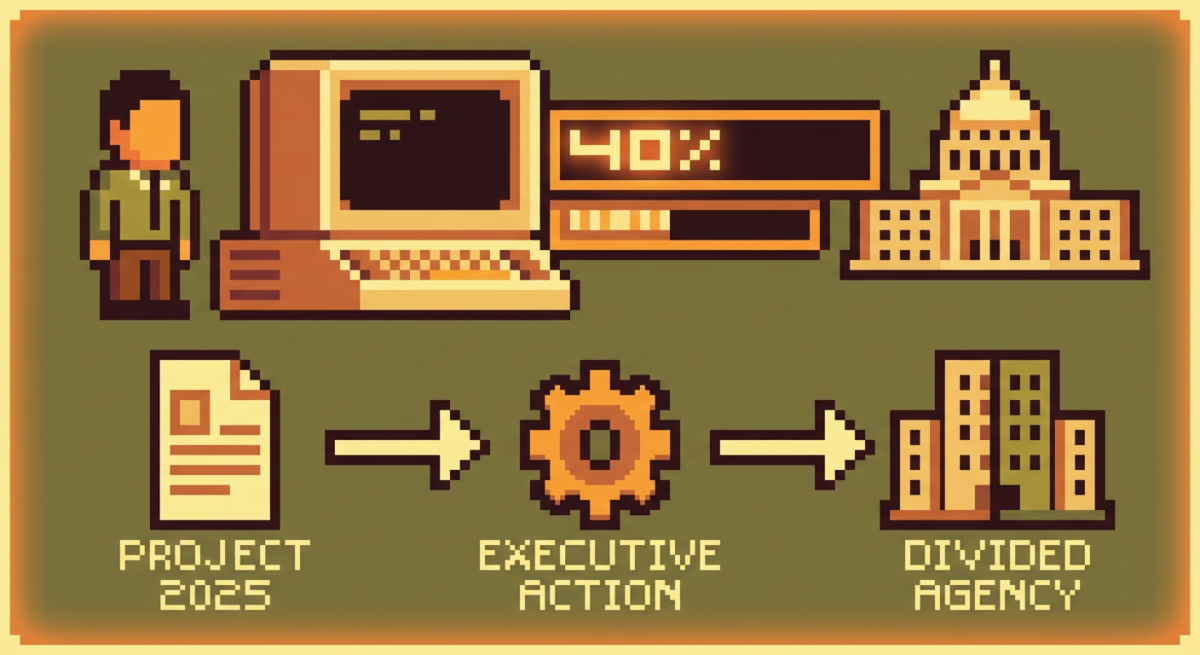
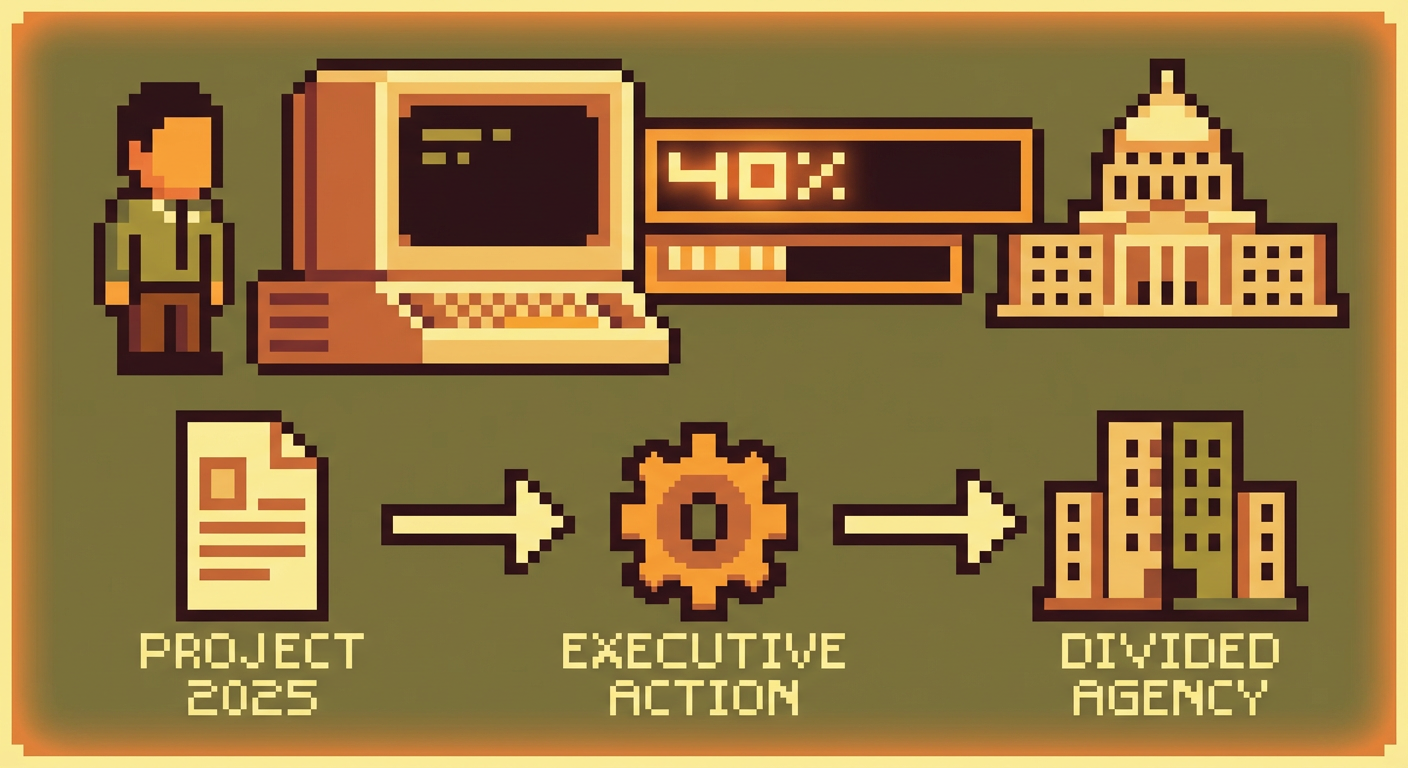
Project 2025’s architects had some clear wins on executive authority. According to a March 2025 analysis from the Brookings Institution Governance Studies Federal Workforce Analysis, roughly 40 percent of the project’s first-year federal agency restructuring recommendations were either partially or fully attempted through executive action. Forty percent. That’s not nothing. That’s demonstrable movement on the agenda.
But then came education policy. The Department of Education elimination was supposed to be a centerpiece. It’s in the document. It’s politically popular with a certain coalition. And it went nowhere, or more precisely, it went to Congress and hit a brick wall. Even with Republican control of the Senate, the math didn’t work. That 60-vote cloture threshold protecting the agency’s authorizing legislation meant you couldn’t just wave an executive pen and make a cabinet department disappear. You needed Democratic votes you weren’t going to get. The Senate filibuster, that old democratic anachronism, turned out to be very much real.
This distinction matters. Executive action could shuffle tens of thousands of civil servants into new classifications. It could reorganize agency priorities and reassign reporting lines. But it couldn’t eliminate a department or rewrite the laws that created one. The Constitution has opinions about this stuff.
The Hidden Cost: What Attrition Actually Reveals
Here’s what keeps me thinking about all this. Federal employee attrition at agencies targeted by efficiency reviews ran at nearly triple the historical baseline rate in the first half of 2025. That data comes from the Partnership for Public Service Federal Workforce Data, and it tells a story that goes beyond the headline numbers.
When you’re trying to reshape government institutions, you’re not just moving boxes on an org chart. You’re creating conditions that affect real people’s lives and, consequently, their decisions about where to work. Experienced civil servants started leaving. Some left out of principle. Some left because the job became untenable. Some left because they saw the writing on the wall and decided to land somewhere else first. The question becomes: what institutional knowledge walks out the door with them? What relationships built over decades get severed? What gets lost that you can’t rebuild by hiring new people, no matter how dedicated they are?
This is where implementation gets messy in ways that policy papers never anticipate. You can technically accomplish a restructuring, reclassify workers, tighten oversight, reorganize chains of command. But if the people who actually know how things work are heading for the exits, you’re left with capability problems that look like success on the org chart but feel different on the ground.
Which Blueprints Actually Survived Contact with Reality
So what actually worked? Schedule F happened. Not completely, not unopposed, but it happened in a substantial way. The reclassification of 50,000 positions is real institutional change, lawsuit or no lawsuit. That counts as implementation.
The executive action restructurings? Most of those advanced, at least partially. If you’re tracking which policy blueprints became reality, executive-action-dependent ones generally did, because the president gets to try things unilaterally and see if courts stop him. That’s how executive power works in practice.
The legislative ones? Those mostly stalled. Education Department elimination, various statutory changes, the things that required Congress to affirmatively do something, all hit the procedural barriers that reliably stop these initiatives. The Senate filibuster, the need for Democratic votes, the complexity of unwinding statutory authorities. These aren’t bugs in the system. They’re features, and they’re how institutional resistance manifests in a separated-powers system.
The Larger Pattern: Implementation Reveals What Was Always True About Power
Here’s what I find genuinely educational about all this, and I mean that word seriously. Implementation of Project 2025 revealed something we ought to have already known but somehow keep forgetting: executive power is real and substantial, but it has a ceiling. That ceiling isn’t rhetorical or theoretical. It’s institutional. It shows up in court and in Congress and in the everyday decisions of 50,000 federal employees trying to figure out what their jobs mean now.
The blueprint was ambitious. Some of it became reality. Some of it didn’t. Most of what became reality involved executive authority. Most of what stalled involved Congress. That’s not unique to this administration. That’s the architecture of how American government actually works, and it works that way by design.
If you’re trying to understand what happens when grand visions meet institutional reality, Project 2025’s implementation record is a useful case study. Not a narrative of complete triumph or complete failure, but an illustration of how power gets distributed, how resistance operates, and where the real limits actually lie. What questions do you have about how these dynamics played out in your own sphere of influence?
